
The earlier articles in this series laid out the long record: decades of neuroscience hype — from the 1990s Decade of the Brain, through the WHO’s 2001 report Mental Health: New Understanding, New Hope, to billions spent on brain research — have produced no validated causes, no cures, and no practical tools that actually help people labelled “mentally ill.”
This 2026 update does not repeat that history. It asks one simple question: has anything changed?
The answer is no.
Psychiatric diagnosis is still based entirely on asking people about their symptoms and observing their behaviour. No blood test, brain scan, genetic test, or other laboratory measure is used in ordinary clinical practice for depression, schizophrenia, bipolar disorder, or any other major condition.
Thousands of potential biological markers have been proposed over the years. As a major 2023 review concluded:
“However, to date, the overwhelming majority of these measures have not been proven sufficiently reliable, valid and useful to be adopted clinically.”
— Abi-Dargham et al., World Psychiatry, 2023. 1
Recent papers in 2025 and 2026 continue to describe the same problem: researchers need clear biological markers to make progress, but the huge variety and overlap between conditions makes finding those markers extremely difficult. New candidates remain experimental tools used only in research studies. None are available for doctors to use with ordinary patients.
Large-scale research programmes and clinical trials continue to produce disappointing results. Global reports from the World Health Organization in 2025 show the burden of mental health problems remains enormous, with services still receiving only a tiny fraction of health budgets. Neuroscience advances have not reduced this gap.
Voices from inside the system
Thomas Insel, who led the U.S. National Institute of Mental Health during the years of heavy investment in neuroscience and genetics, has not changed his earlier assessment. He now emphasises the need for broader social and environmental approaches — an implicit admission that the brain-focused research push alone has not delivered the expected results.
David Kingdon, Emeritus Professor of Mental Health Care Delivery at the University of Southampton, put it clearly in 2021:
“But does this not seem, after more than 30 years of failure, more akin to a religious or, albeit culturally influenced, persistent strong belief than one based on scientific grounds? Just where is the rational justification for ploughing the same furrow again and again?”
— David Kingdon, Why hasn’t neuroscience delivered for psychiatry? (2021) 2
Per Lanterna’s view
There may be a legitimate use for neuroscience, but the current direction is misdirected and is getting nowhere. The strong fixation on biological psychiatry — the belief that every mental problem is primarily a brain disorder to be fixed with drugs or high-tech equipment — has delivered nothing but expensive machinery, repeated promises, and patients kept on symptom-masking treatments for years or decades.
Psychiatry needs a complete rethink. It must abandon the almost religious belief that the causes of what is called “mental illness” reside mainly or exclusively in the brain. The honest search must be for real causes — wherever they actually exist: trauma, difficult life circumstances, social conditions, environment, or elsewhere. If researchers open their eyes and look beyond the scanners and the laboratory, they may discover they have little need for their expensive equipment — or ultimately, for the psychiatric model itself.
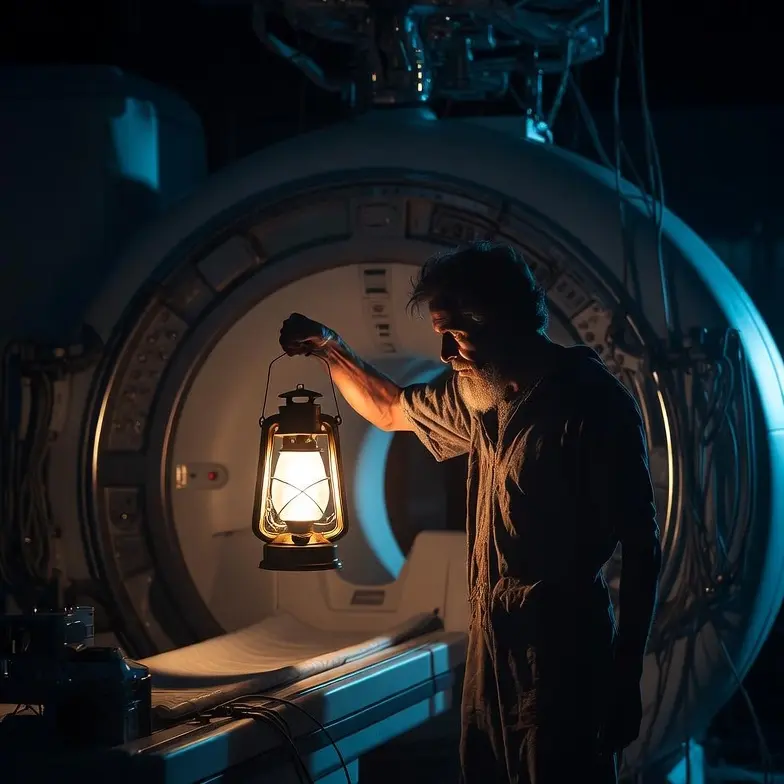
The lantern continues its search. The darkness of unproven claims grows no lighter. More lanterns are needed.

Machine learning failed to find biomarkers for Major Depressive Disorder

2. Rockefeller Foundation and the failure of psychiatry as a science

Neuroscience is failing psychiatry
- Abi-Dargham A, Moeller SJ, Ali F, DeLorenzo C, Domschke K, Horga G, Jutla A, Kotov R, Paulus MP, Rubio JM, Sanacora G, Veenstra-VanderWeele J, Krystal JH. Candidate biomarkers in psychiatric disorders: state of the field. World Psychiatry. 2023 Jun ↩︎
- Kingdon D. Why hasn’t neuroscience delivered for psychiatry? BJPsych Bulletin. 2020;44(3):107-109. doi:10.1192/bjb.2019.87 ↩︎

Newsletter Signup
Signup for our newsletter and don't miss a step. Follow the lantern...