
Per Lanterna
“By the lantern”
In the Nineteenth century psychiatry promised a new dawn for mental health. Instead, it has delivered a perpetual night of symptom suppression, ever-expanding diagnoses, and a pharmaceutical profit machine that treats patients as repeat customers. Nowhere is this clearer than in Australia’s Pharmaceutical Benefits Scheme (PBS) data.
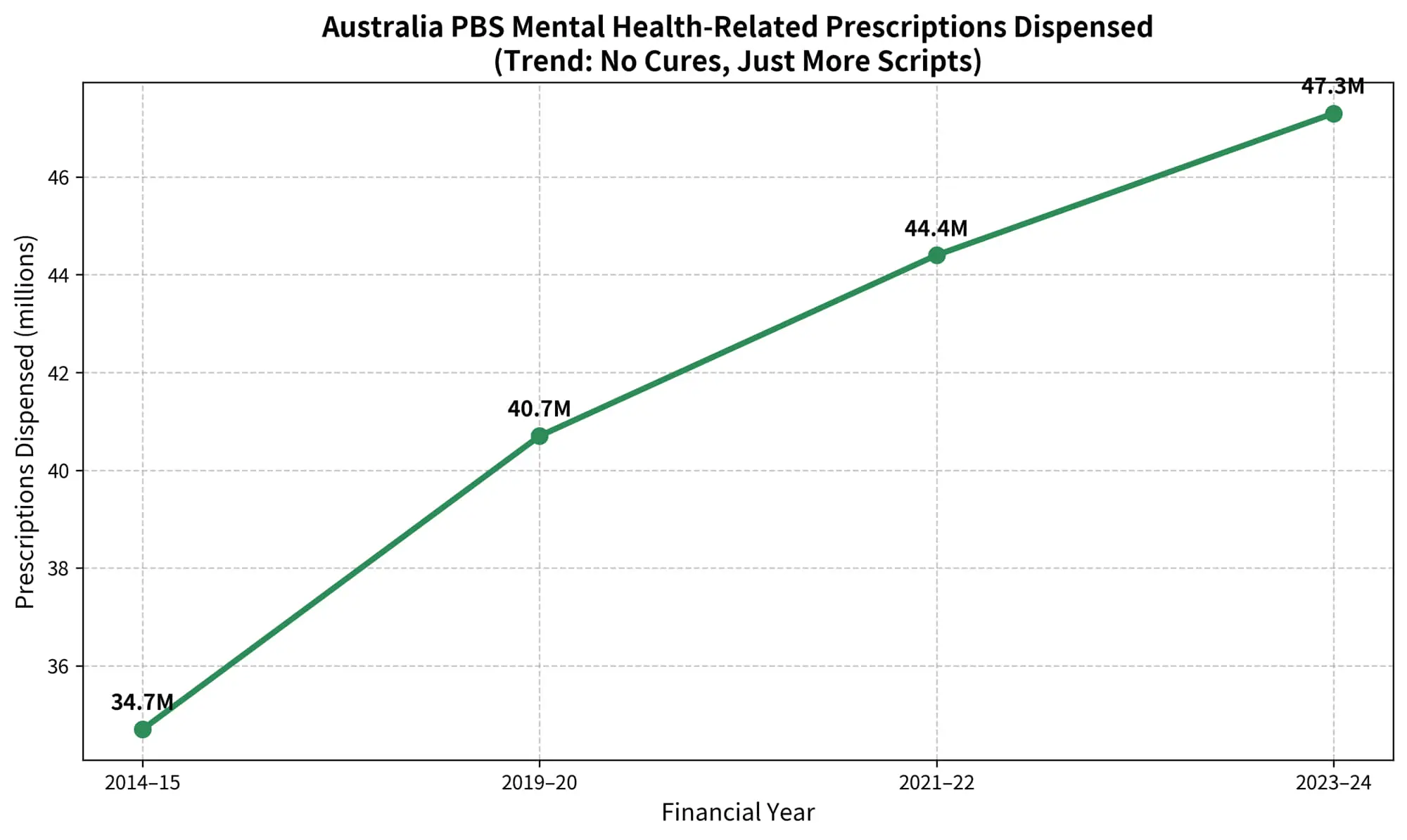
According to the latest Australian Institute of Health and Welfare (AIHW) figures for 2023–24, 47.3 million mental health-related prescriptions were dispensed across the country — a 37% increase since 2014–15. That is enough scripts to give every man, woman and child in Australia more than one and a half prescriptions each. Approximately 5 million Australians (18% of the population) received at least one such prescription. Government spending on these subsidised mental health medications reached $747 million in the same year.
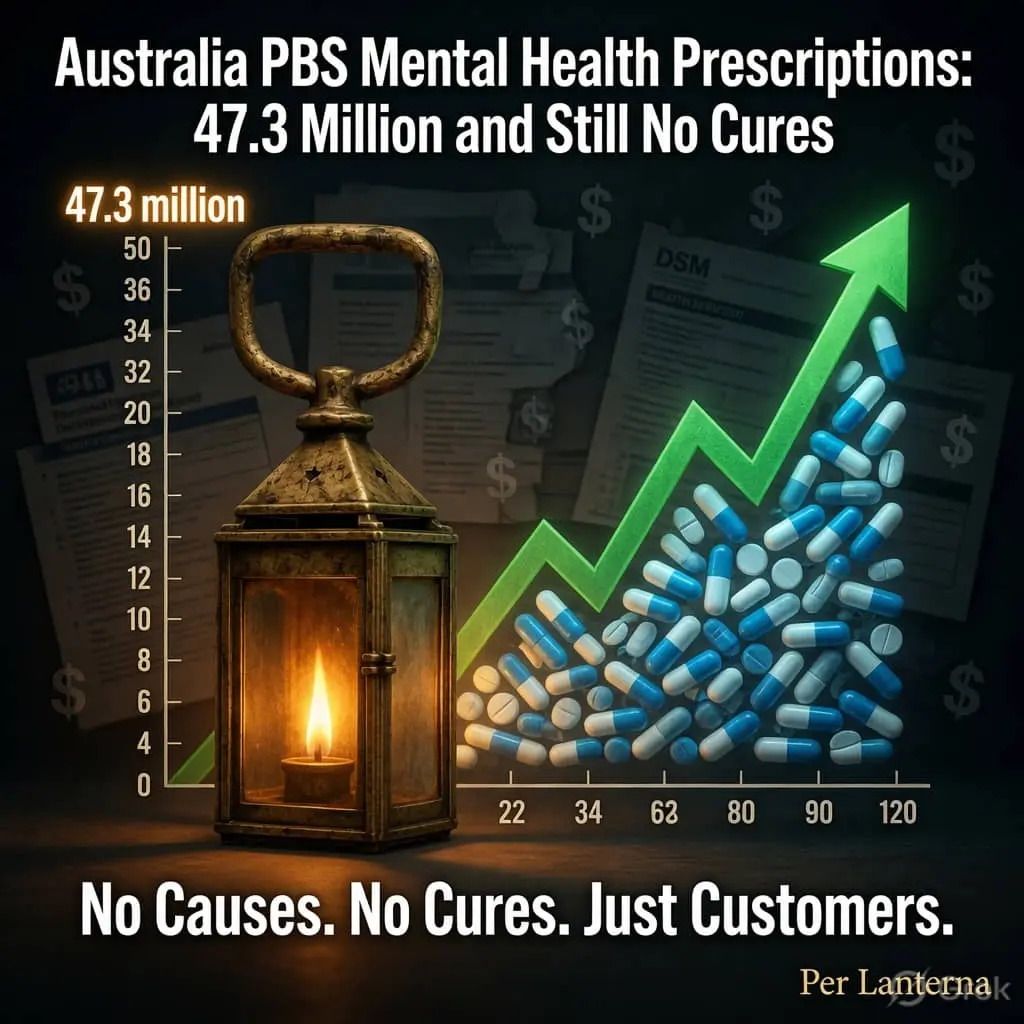
These are not one-off treatments leading to recovery. They are ongoing supplies of drugs whose sole documented effect is to mask symptoms — exactly as described in Part 3: Psychiatry’s lack of science masked by pharmaceuticals. No causes have been found. No cures have been delivered. The underlying conditions remain untouched while the scripts keep flowing.
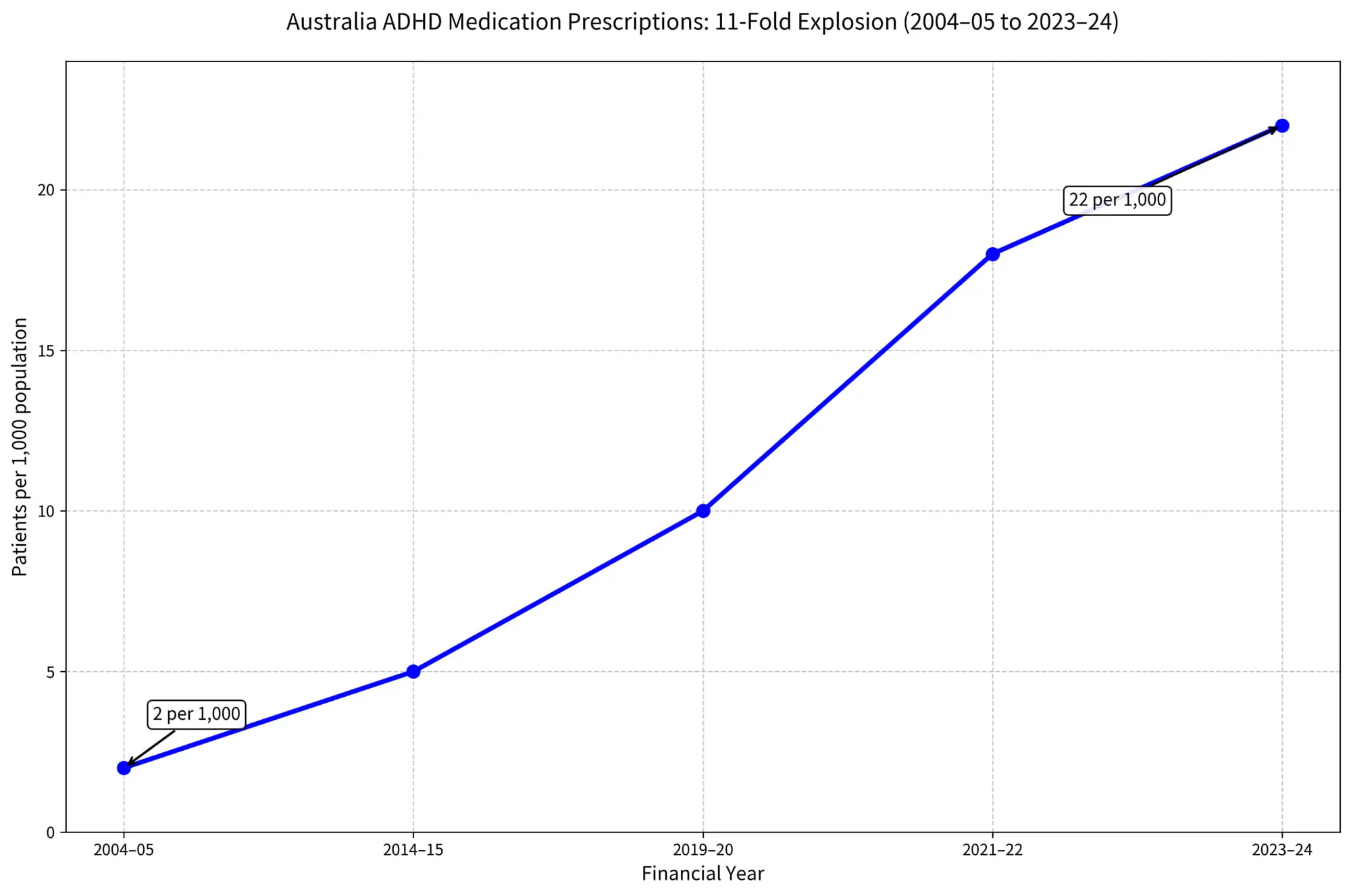
The ADHD Surge: A Tenfold Explosion in Little More Than a Decade
The most dramatic illustration of this pattern is the explosion in ADHD medication. AIHW data show the population rate of ADHD prescriptions increased 11-fold from 2 patients per 1,000 in 2004–05 to 22 per 1,000 (2.2% of the Australian population) by 2023–24. Independent research confirms the number of children and adolescents (5–17 years) on ADHD medication rose more than tenfold in 20 years — from 20,147 people (0.5% of that age group) in 2003 to 246,021 (4.2%) in 2022. By 2025, nearly 1 million Australians were on ADHD drugs, with 6.7 million scripts written for 837,937 patients in one recent calendar year alone.
Adult use has followed the same trajectory: the proportion of adults (20–64) taking ADHD medicines rose more than six-fold from 0.35% in 2016–17 to 2.36% in 2025. PsychostimulantsDrugs that stimulate and speed up the responses of the centr... (methylphenidate, dexamfetamine, lisdexamfetamine) make up the overwhelming majority (87% in 2023–24) of these prescriptions.
These are not cures. They are stimulants that temporarily improve focus by altering brain chemistry — the modern equivalent of the old asylum drugs that psychiatrists themselves admitted were simply chemical restraints. The diagnosis of ADHD has ballooned, new adult-onset cases have been added to the PBS, and the drugs keep being dispensed year after year. Exactly as Part 4: ‘Mental health’ is defined and controlled by profit-driven commercial interests warned: no cures equals billions in drug profits, and patients become lifelong repeat customers.
Psychiatry’s Business Model on Full Display
This is not health care — it is a business model. As former National Institute of Mental Health schizophrenia chief Loren Mosher wrote in his 1998 resignation from the American Psychiatric Association:
“This is not a group for me. At this point in history, in my view, psychiatry has been almost completely bought out by the drug companies… Psychiatrists have become the minions of drug company promotions… No longer do we seek to understand whole persons in their social contexts rather we are there to realign our patients’ neurotransmitters.”
Australia’s PBS data prove Mosher’s point on a national scale. Antidepressants still dominate (around three-quarters of scripts in recent years), followed by antipsychotics, anxiolyticsA type of drug that addresses anxiety. Anxiolytics can lead ... and now the surging psychostimulantsDrugs that stimulate and speed up the responses of the centr.... The Diagnostic and Statistical Manual (DSM) keeps adding new symptom clusters; the drugs keep flowing; the underlying science remains absent.
Part 0 of the Real Story Of Psychiatry series put it bluntly:
“No psychiatric treatments have ever been based on any scientific discovery of the cause of anything psychiatry calls ‘mental illness’ and no causes have ever been found. Treatments are entirely based on hiding symptoms… No actual cures for any ‘mental illness’ have been found.”
The PBS explosion is living proof.
Time to Light the Lantern
Per Lanterna carries the lantern into the darkest corners. Australia’s PBS statistics illuminate one of the darkest: a taxpayer-subsidised system that has scaled up symptom-masking drugs tenfold in some categories while delivering zero cures and zero scientific understanding of causes.
The real story of psychiatry is written in these prescription numbers.
We will continue to publish the full series and the primary documents so Australians can see for themselves. The lantern is lit. The question is whether enough honest people are willing to look.
Read the full series
- 0. The really simple story of psychiatry
- 3. Psychiatry’s lack of science masked by pharmaceuticals
- 4. ‘Mental health’ is defined and controlled by profit-driven commercial interests
Sources (AIHW Mental Health-Related Prescriptions data 2023–24 and related reports; peer-reviewed analyses of PBS records 2003–2025).
The darkness is not inevitable. Time for more lanterns.
Newsletter Signup
Signup for our newsletter and don't miss a step. Follow the lantern...