Kinderfachabteilungen – the Special Children’s Killing Wards
The killing of children was not only part of Aktion T4; it was where the program began.
In October 1939 Hitler empowered his personal physician Karl Brandt and Führer Chancellery head Philipp Bouhler, in association with German psychiatry, to grant “mercy death” to those considered incurable.
Aktion T4 came into existence.
The child component was immediately activated and operated as Kinderfachabteilungen (Children’s Special Departments or Special Children’s Wards).
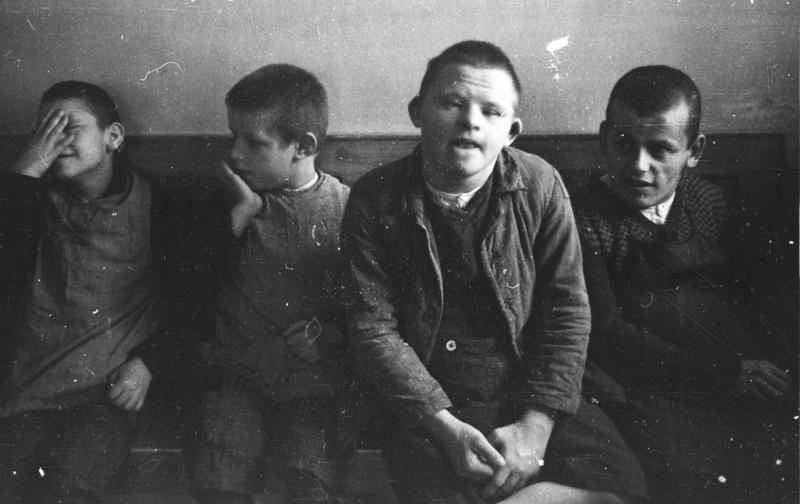
Operation of the Child Euthanasia Programme
On 18 August 1939 the Reich Ministry of the Interior ordered doctors, nurses and midwives to report newborns and children under three with severe disabilities. Parents were told their children would receive special treatment in designated paediatric wards. These facilities functioned as killing centres.
It began with infants and toddlers, then expanded to children and youths up to age 17.
Children underwent assessment, often lasting several weeks, followed by killing through lethal overdose of medication (commonly Luminal/phenobarbital or morphine), deliberate starvation, or lethal injection (frequently phenol). Death certificates recorded fabricated causes such as pneumoniaA serious illness where infection within the lungs results i... More.
Children were “assessed” for a few weeks by supervising psychiatrists (often involving painful tests or observation), then murdered. Brains and organs were then frequently harvested for psychiatric “research”.
Conservative estimates indicate at least 10,000 disabled children were killed across more than 30 Kinderfachabteilungen in Germany and Austria during the war years. By 1941 more than 5,000 children had already been killed.
Cleaning the ‘gene pool’
This activity was pushed by German psychiatrists to “clean the German geneA hereditary part of an individual, located in each of his c... More pool”. Psychiatry’s doctrine on the subject is possibly best expressed by Kraepelin’s successor Ernst Rudin, then president of both the Society of German Neurologists and Psychiatrists (GDNP) and the International Federation of Eugenics Organizations – such ideas were far from ‘fringe’.
The following is from a submission by Rudin regarding how best to determine which children should be exterminated:
“…distinguishing which children could, already as children, be clearly categorized as so valueless and worthy of elimination that…they could be recommended for euthanasia in their own interest and that of the German people.”
Ernst Rüdin. 1942. From a proposal /memorandum from Ernst Rüdin to Reich Health Leader and SS officer, Leonardo Conti.
Research Linked Directly to Killings
Between 1943 and 1945, psychiatrist Julius Deussen coordinated hereditary-psychological research in collaboration with Carl Schneider at Heidelberg University Psychiatric Clinic.
Julius Deussen was the head of the Department for Hereditary Psychology at Kraepelin’s German Research Institute for Psychiatry in Munich which was then being run by his successor Ernst Rüdin.
Children were selected from killing wards (Kinderfachabteilungen), brought to Heidelberg for extensive clinical and psychological testing and observation, and then transferred — primarily to the Eichberg asylum — where they were killed. At least 52 children went through this programme. At least 20 were murdered specifically so their brains could be removed immediately after death and examined in Heidelberg. The research design, which from the beginning incorporated the killing of the children, had central elements formulated by Deussen while still working at Rüdin’s institute. Rüdin supported and funded the work from the budget of his Munich institute and described it as important for Nazi health and population policy.
At least 52 children went through this programme. At least 20 were murdered specifically so their brains could be removed immediately after death and examined in Heidelberg.
Am Spiegelgrund
To illustrate the ‘Children’s Special Wards’, one of the largest was the notorious Am Spiegelgrund, as part Vienna’s Steinhof psychiatric complex.
One of the largest centres was Am Spiegelgrund in Vienna, where 789 children were murdered by injection, gas, starvation, and abuse between 1940 and 1945.
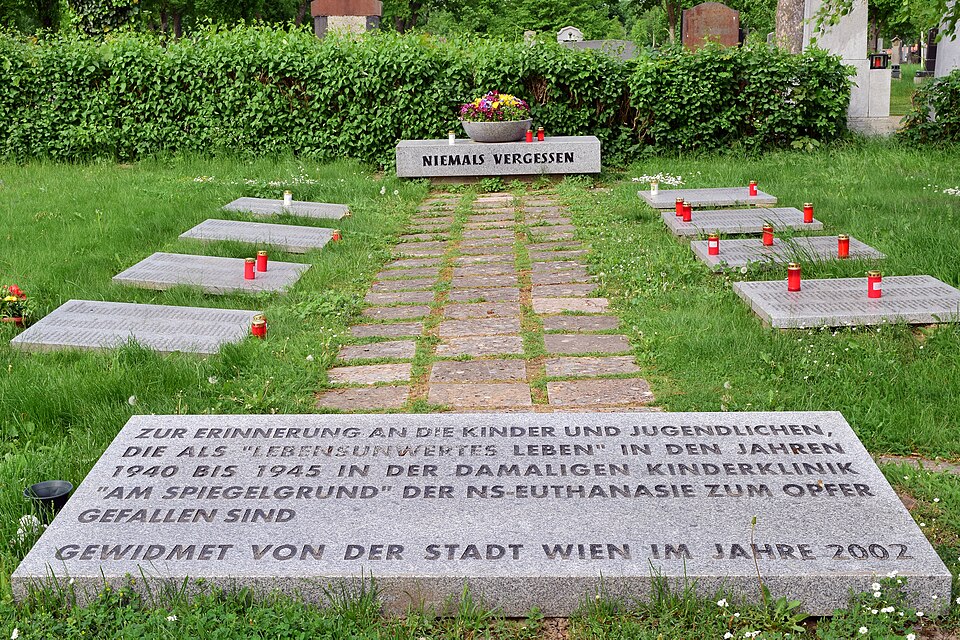
The memorial to the children of Am Spiegelgrund .
The plaque reads:
“Here lie the remains of 789 children who died in the children’s ward of the Am Spiegelgrund hospital during the Nazi era and were abused for medical research by Heinrich Gross, among others, before and after their death.”
It was run by psychiatrist Ernst Illing (who was later executed for his crimes). Beneath him were three other psychiatrists who ran the core process — filling out assessment questionnaires based on speculative hereditary criteria, deciding “life unworthy of life,” ordering transfers to killing wards, and often directly administering lethal injections or overdoses. They framed it as “therapy” or “research.”
Notable among them was Heinrich Gross the Senior doctor / psychiatrist who experimented on living child and collected the brains of those murdered.
The Final Victim
The final known victim of the entire Aktion T4 programme was a child: four-year-old Richard Jenne, killed by lethal injection on 29 May 1945, more than three weeks after Germany’s surrender.
Newsletter Signup
Signup for our newsletter and don't miss a step. Follow the lantern...