ADHD Medication Poisonings Quadruple in a Decade
The latest research from Australia delivers a stark, data-driven indictment of psychiatry’s primary “solution” for attention deficit hyperactivity disorder (ADHD): powerful psychotropic medications that suppress symptoms but deliver no cures, no root-cause fixes, and now a surging public health crisis of poisonings.
Published in the Australian and New Zealand Journal of Psychiatry (2026), the retrospective study Exposures to attention deficit hyperactivity disorder medications reported to the New South Wales Poisons Information Centre (2014-2023): A retrospective study by Amy Thomson and colleagues (Thomson et al., 2026) analysed 17,299 human exposure cases reported to the NSW Poisons Information Centre over ten years. The results are unambiguous and alarming:
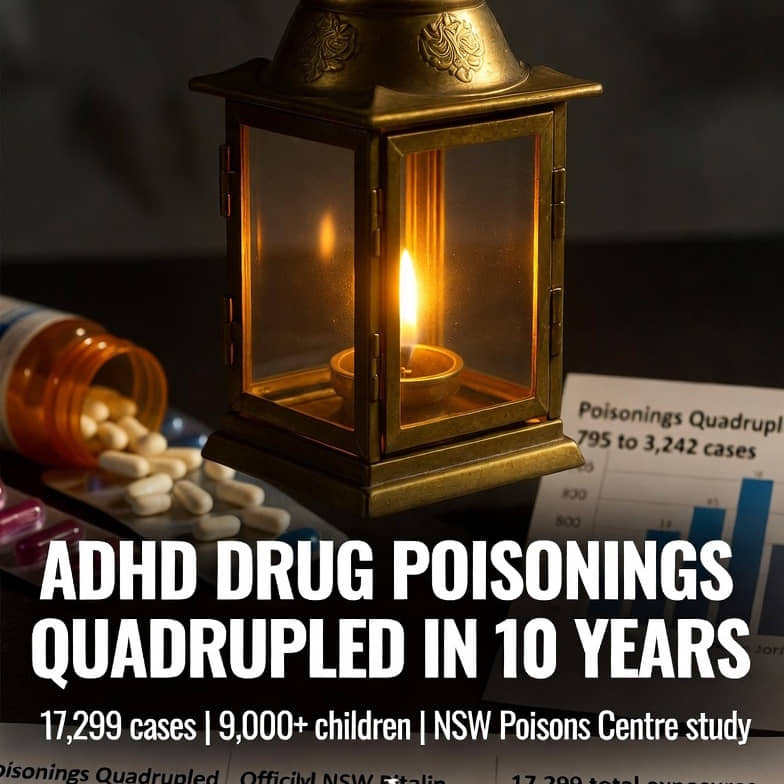
- Poisoning exposures rose 16.5% annually (95% confidence interval: 15–18%).
- By 2023 the annual figure had reached 3,242 cases – more than four times the 795 cases recorded in 2014.
- Children and adolescents bore the brunt: more than 9,000 exposures involved those under 15; 72% of accidental poisonings occurred in this age group.
- Over half (9,657) of all cases resulted in hospital referral.
- A strong positive correlation existed between exposures and the number of prescriptions dispensed nationally (R² = 0.94).
The six ADHD medications tracked – atomoxetine, clonidine, dexamphetamine, guanfacine, lisdexamfetamine and methylphenidate (Ritalin) – are the very same symptom-masking agents psychiatry has pushed for decades. Clonidine and methylphenidate each accounted for 35% of reports and the highest number of hospital presentations. Clonidine – originally developed for hypertension and often prescribed in quarter- or half-tablet doses – proved particularly hazardous, with poisonings rising disproportionately to prescription volume. As lead author Amy Thomson (PhD candidate, University of Sydney School of Pharmacy) noted in the University’s release: “Just one double dose of clonidine can put a child in hospital.”
“Just one double dose of clonidine can put a child in hospital.”
Amy Thomson PhD candidate, University of Sydney School of Pharmacy
The University of Sydney’s accompanying article (12 November 2025) makes the scale personal: more than half of the 17,000+ self-reported cases led to hospital admission. While 60% were accidental (dosing errors, sibling access, parental miscommunication), 38.5% were deliberate misuse. Researchers warn the true toll is likely higher because the data captures only those who contacted the poisons hotline or presented to hospital.
This is not an isolated “oops” in an otherwise safe medical practice. It is the predictable outcome of psychiatry’s long-documented model: diagnose more people (Australian ADHD diagnoses more than doubled between 2013 and 2020), write more prescriptions, and create a growing pool of repeat customers on drugs that have never cured anyone. As Per Lanterna’s series The real story of psychiatry has repeatedly shown, no psychiatric treatment has ever been based on a discovered cause of “mental illness,” and none has ever delivered an actual cure. These medications merely hide symptoms while carrying serious risks – exactly as the poisons data now quantifies.
The study’s authors declare no conflicts of interest and call for “targeted preventive measures focused on both the use of the medication being prescribed as well as considering the circumstances and safety of the individual and household.” That is the bare minimum. The deeper question Per Lanterna has been asking since Part 0 remains unanswered by psychiatry: why are we flooding children and adults with brain-altering chemicals whose only proven effect is symptom suppression, when the underlying condition is never addressed and the harms – including this quadrupling of poisonings – are now statistically undeniable?
The research is senior source: nationwide poisons-centre data, peer-reviewed, covering an entire decade, with clear statistical correlations to prescription volumes. It stands as further evidence that psychiatry’s “chemical imbalance” marketing and ever-expanding diagnostic manuals (DSM) have turned mental health into big business while patients – especially children – pay the price in emergency departments.
The lantern is lit. This is not care; it is a public health experiment with known, escalating harms. Families, doctors and regulators must now confront the data: more diagnoses and more pills have not produced healthier children – only more poisonings. Until psychiatry admits it has found neither cause nor cure and stops pretending otherwise, the human cost documented by Thomson et al. (2026) will continue to rise.
Reference Thomson, A.B., Cairns, R., Magotra, H., Noghrehchi, F., Buckley, N.A. (2026). Exposures to attention deficit hyperactivity disorder medications reported to the New South Wales Poisons Information Centre (2014-2023): A retrospective study. Australian and New Zealand Journal of Psychiatry. DOI: 10.1177/00048674251384053
Further reading from the Per Lanterna series (perlanterna.com):
- Part 3: Psychiatry’s lack of science masked by pharmaceuticals
- Part 4: ‘Mental health’ is defined and controlled by profit-driven commercial interests
The search for honest answers continues.
Newsletter Signup
Signup for our newsletter and don't miss a step. Follow the lantern...