
National Constitution Center
Exactly 92 years after the infamous Buck v. Bell decision, the Center presents a partial screening of “A Dangerous Idea: Eugenics, Genetics and the American Dream”—an award-winning documentary exploring the legal history of the eugenics movement in the United States. Following the screening, join the film’s co-writer and executive producer Andrew Kimbrell, acclaimed author and journalist Daniel Okrent, and law and bioethics scholars Paul Lombardo and Dorothy Roberts for a conversation exploring the dark history of eugenics and the Constitution.
This powerful documentary (and the accompanying National Constitution Center panel) exposes one of America’s darkest chapters: the early 20th-century eugenics movement, which forcibly sterilized tens of thousands of Americans under the banner of “better breeding.” The film centres on survivor Elaine Riddick Jesse, a poor Black girl from North Carolina raped at 13, labelled “feeble-minded” by a social worker, and surgically sterilised without consent after giving birth—purely because she was Black, poor, and from a troubled family. Her story is heartbreaking and emblematic.
Eugenics was not fringe pseudoscience but mainstream “science” embraced by top psychiatrists, psychologists, politicians, and institutions during the Gilded Age. Wealthy industrialists funded it to blame social ills on defective genes rather than poverty, exploitation, or environment. Harry Laughlin’s model sterilization law—used in North Carolina—was upheld by the U.S. Supreme Court in Buck v. Bell (1927) with Oliver Wendell Holmes’s infamous line: “Three generations of imbeciles are enough.” The U.S. exported these ideas; the Nazis studied and expanded them.
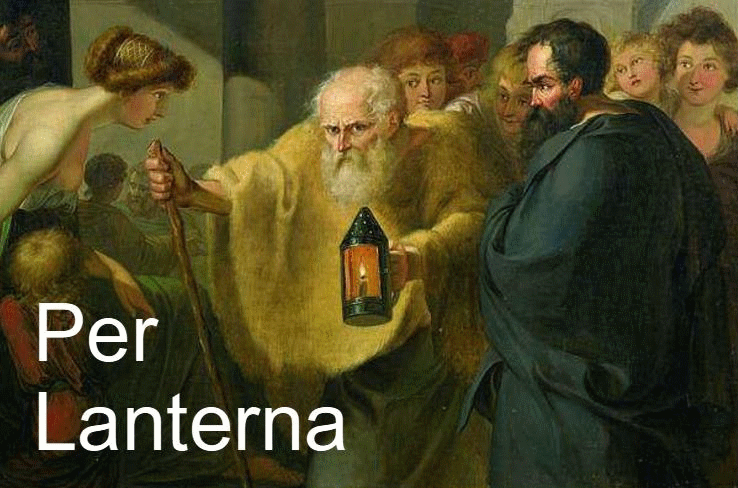
Per Lanterna’s lens reveals the psychiatric dimension: Psychiatry supplied the “scientific justification” for eugenics, framing undesirable mental states and behaviours as hereditary threats requiring prophylacticdescribing things done which were to guard against a disease... social control. Many leading psychiatrists served as medical directors of eugenics boards and associations, turning speculative theories about the “mentally ill” into state policy that stripped citizens of reproductive rights.
The film and panel rightly warn that enthusiasm for “forward-thinking” science can mask profound abuses of power. Eugenics was never truly defeated—it mutated. Today’s debates over genetics, designer babies, and psychiatric genetic determinism echo the same dangerous idea: that biology is destiny and experts should direct human evolution.
Per Lanterna’s mission—to peer into psychiatry’s darkest corners—makes this essential viewing.
Psychiatry’s historic role in eugenics is not ancient history; it is a cautionary lantern for anyone trusting the field with ever-greater social authority.

5. No psychiatry, you can’t take over the world

A History of Eugenics
Newsletter Signup
Signup for our newsletter and don't miss a step. Follow the lantern...